A power of attorney (POA) is a legal document that authorizes a person, the principal, to appoint another individual, the agent, to make decisions and act on their behalf. These decisions may involve finances, property, business matters, or medical care, depending on the type of authority granted. In Texas, several POA options exist to fit different personal and legal needs.
At Texas Horizons Law Group, our New Braunfels estate planning attorneys work with individuals and families across the state to draft power of attorney documents that reflect your goals and circumstances.
What Is a Power of Attorney?
A power of attorney (POA) is a legal document that grants one person the authority to act on another's behalf. This authority can be broad or limited and may apply to financial matters, property transactions, business affairs, or medical decisions. A POA is typically created while the principal still has legal capacity, allowing decisions to be handled without court involvement if circumstances change.
In Texas, powers of attorney are commonly used to prepare for illness, absence, or future incapacity, giving families a clear and legally recognized way to manage affairs when the principal cannot act personally.
Choosing the Right Power of Attorney for Your Needs in Texas
Power of attorney documents come in several forms, each designed for specific situations. In most cases, a POA is used to manage money, real estate transactions, medical treatment, or long-term care when a person is unable to handle these matters alone. The tasks an agent can perform are listed under the types of attorney grants described in the document, which may include healthcare, property, or financial matters.
1. General Power of Attorney
A general power of attorney allows the agent to manage a wide range of legal and financial matters on the principal's behalf. This is often used by individuals who travel frequently, serve in the military, or need help managing daily financial affairs. It's also helpful in situations where someone anticipates being temporarily unavailable, such as hospitalization or extended time out of state.
This includes:
- Managing bank accounts;
- Paying bills and handling taxes;
- Buying or selling property;
- Making business decisions;
- Handling government benefits.
This type ends if the principal becomes incapacitated, unless it is also made durable.
2. Durable Power of Attorney
A durable POA is commonly used by older adults or those with declining health who want to make sure someone can continue to manage their financial matters if they become mentally or physically incapacitated. This type is also a central tool in most long-term estate planning strategies.
A durable power of attorney remains effective even if the principal becomes mentally or physically incapacitated. This makes it suitable for long-term planning, especially for older adults, individuals with chronic health issues, or those entering a nursing home.
Durable powers are commonly used to:
- Ensure continuous access to funds;
- Maintain real estate;
- Oversee personal business or investments;
- Make arrangements for long-term care and insurance claims.
Texas Estates Code §751.0021 requires clear language in the document to ensure that durability is preserved.
3. Medical Power of Attorney

This type is suitable for anyone who wants to clearly document who can speak to medical professionals and make healthcare decisions in the event they are unconscious, sedated, or mentally unable to communicate. It is especially relevant for those undergoing major surgery, dealing with chronic illness, or entering a care facility.
This form grants the agent authority to make medical care decisions if the principal is unable to do so. It does not extend to financial or legal matters.
Key actions to be taken include the following:
- Consenting or declining treatment;
- Accessing protected health information and medical records;
- Making decisions about surgeries, medications, or long-term care facilities.
The agent's authority begins only when physicians certify that the principal cannot make their own medical decisions. For requirements, refer to Texas Health and Safety Code §166.164.
4. Springing Power of Attorney
This is often selected by individuals who prefer that no authority be transferred unless they are proven incapacitated. It is sometimes used by people who want to retain full control of their affairs while still putting a safety net in place if a medical event or accident occurs.
A springing power of attorney only takes effect upon the occurrence of a specific event, usually when the principal becomes incapacitated. It can apply to either financial or medical matters, depending on how it's drafted.
Conditions must be clearly defined in the document, such as:
- A letter from a physician confirming incapacity;
- Court determination of mental incompetence.
This approach delays the agent’s authority until needed, adding a layer of security but also complexity.
5. Limited or Special Power of Attorney

This works well for specific or one-time situations, such as selling property while overseas, managing a bank account while traveling, or handling a legal matter without being physically present. Business owners may also use it to delegate signing authority during short absences.
Used for a specific task or for a limited duration, this type does not grant broad powers. Examples encompass:
- Selling a specific property;
- Managing an account for a brief period;
- Handling legal affairs while the principal is overseas.
The document must describe the task or purpose clearly and end once it is completed or the time limit expires.
Similarities and Differences Between POA Types
Each power of attorney type includes shared features, but they vary in purpose, timing, and legal effect. Comparing their traits side by side can help clarify which one fits your needs.
How to Create a Power of Attorney in Texas
Creating a POA document that meets Texas requirements involves:
- Identifying the correct form (Statutory Durable POA or Medical POA);
- Clearly stating the powers granted (general, specific, medical, or springing);
- Signing in the presence of a notary (and witnesses, for some medical forms);
- Distributing signed copies to relevant parties, including banks, doctors, and legal representatives.
If you wish to appoint a trusted individual to make financial and healthcare decisions on your behalf in your absence, it is recommended that you create a POA. Please ensure your POA is kept up to date and reviewed regularly to accurately reflect your current wishes and circumstances.
Common Mistakes to Avoid When Setting Up a POA
While a power of attorney can simplify future decisions, certain missteps during setup may limit its usefulness or create legal issues:
- Naming someone without fully trusting their judgment or integrity;
- Granting overly broad powers without understanding the impact;
- Forgetting to make the document durable if ongoing authority is needed during incapacity;
- Failing to meet Texas signing or witnessing requirements;
- Not informing financial institutions or medical providers about the document;
- Letting outdated POAs remain in place after life changes (divorce, relocation, etc.).
Tips for Using a Power of Attorney Effectively
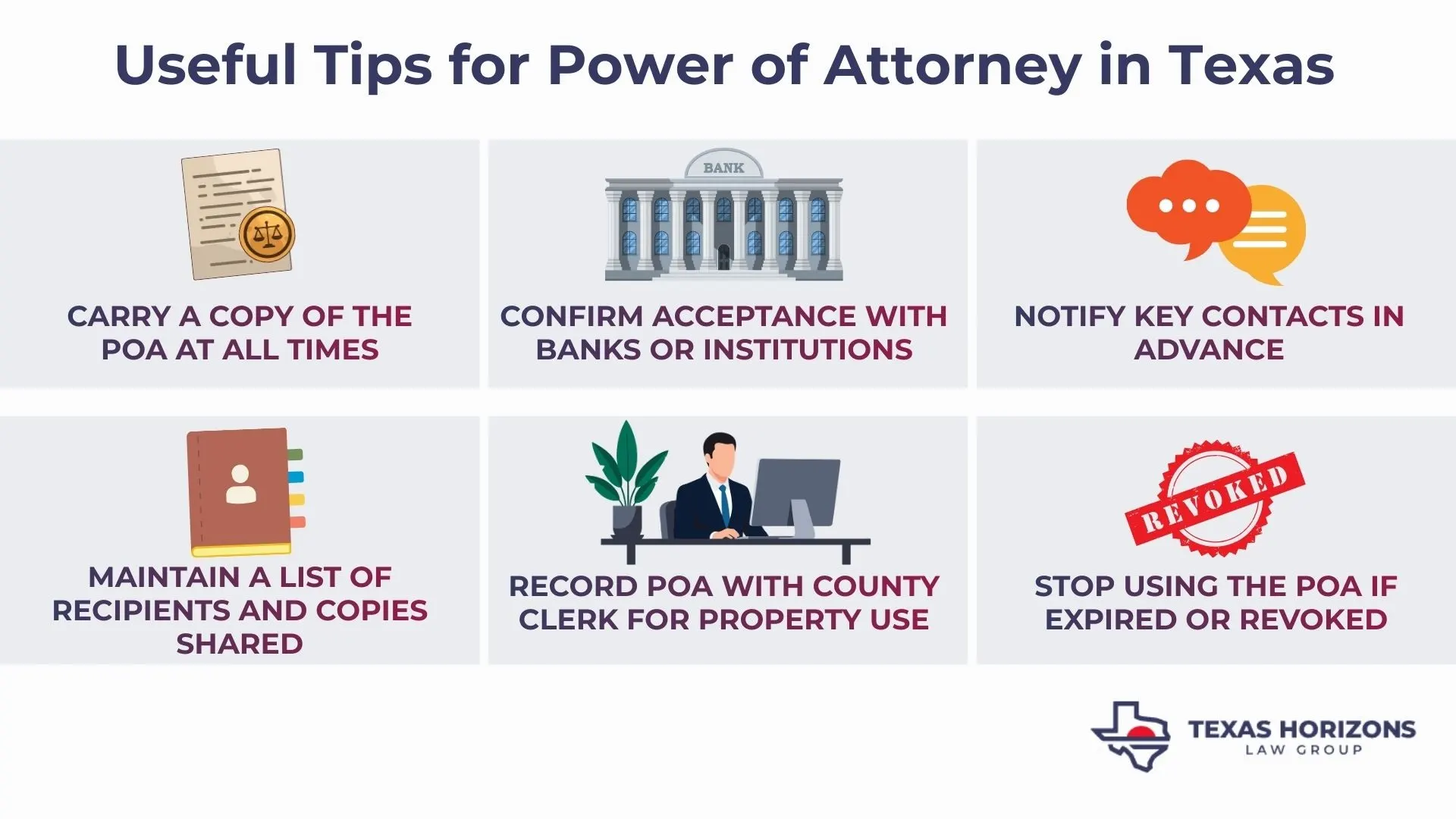
A power of attorney allows the agent to act on behalf of the principal, but the document must be used properly to be effective. Agents have responsibilities and must follow the scope of authority granted to them. The following steps can help make the process more straightforward and avoid delays when third parties become involved:
- Agents should carry a copy of the POA document when acting on the principal's behalf.
- Banks and hospitals may request validation before accepting the agent's authority.
- It is wise to notify institutions in advance and keep a list of who has a copy.
- For real estate transactions, the POA may need to be recorded with the county clerk.
A POA ends when the principal dies, revokes the document, or the task is complete. In some cases, such as divorce, naming a spouse as an agent may automatically revoke their authority.