Picture the following scenario: A sudden medical emergency can leave a loved one unable to communicate. The doctors have requested consent for a surgical procedure, and the bank requires a signature to release funds for the hospital bills. Who holds the legal authority to intervene in these matters?
At Texas Horizons Law Group, we work with families across Texas as they face complex legal decisions. We do not handle guardianship proceedings per se. Instead, we help families evaluate whether guardianship may become an issue and take proactive steps to reduce or avoid court involvement whenever possible. Our estate planning and probate attorneys serve clients statewide, with a primary presence in New Braunfels and Seguin.
What Is a Power of Attorney

A power of attorney (POA) is a legal document that allows you (the "principal") to appoint a trusted person (the "agent" or "attorney-in-fact") to manage your affairs. A key component of a POA is that it must be established prior to the loss of mental capacity to comprehend it. It is a voluntary delegation of authority that keeps the courts out of your private life.
In Texas, there are two main types of Power of Attorney that must be understood:
1. Statutory Durable Power of Attorney
This document covers your financial affairs under the Texas Estates Code Chapter 751. "Durable" means the power remains effective even if you become incapacitated. It grants your agent wide-ranging authority to handle transactions as follows:
- Paying bills and managing bank accounts
- Buying or selling real estate
- Filing taxes and managing investments
- Applying for government benefits like Medicaid
Without a durable power of attorney, your family may not be able to access your individual bank accounts or sell your home to pay for your care without a court order.
2. HIPAA Authorization and Medical Powers of Attorney

This document is strictly for healthcare decisions outlined in Texas Health and Safety Code Chapter 166. It allows your agent to make medical decisions on your behalf, but only if your attending physician certifies in writing that you are unable to make them yourself. Federal privacy rules under HIPAA can prevent doctors and hospitals from sharing records unless a valid HIPAA authorization is in place.
A HIPAA waiver allows the named agent to:
- Speak directly with physicians and medical providers
- Access medical records and test results
- Make informed treatment decisions when capacity is lost
A medical power of attorney also allows your agent to address medical issues that may arise if you become incapacitated. However, without a HIPAA authorization, medical providers may limit communication, even with a valid Medical Power of Attorney, causing delays during emergencies.
What Is Guardianship?
Guardianship is a legal relationship created by a court under the Texas Estates Code, Title 3. Guardianship is a court-appointed role in which the court formally designates an individual to make decisions for someone who cannot care for themselves. This differs from powers of attorney.
This measure is typically reactive, taken when an individual (the "ward") has already lost the mental capacity to make sound decisions and has no valid power of attorney in place.
Because guardianship involves stripping an adult of their legal rights, Texas courts view it as a last resort. The process is designed to protect vulnerable people, but it entails significant court oversight and costs.
There are two categories of guardianship defined in Texas Estates Code Chapter 1002:
- Guardian of the person: Responsible for the ward's physical well-being, including food, shelter, and medical care decisions.
- Guardian of the estate: Responsible for managing the ward's property and financial assets.
When Do You Need a Guardianship?

While a power of attorney is generally preferred, guardianship serves a vital role in certain circumstances. Guardianship should be considered only when necessary to protect an individual who can no longer manage their own affairs safely, while retaining as much control over their life as possible.
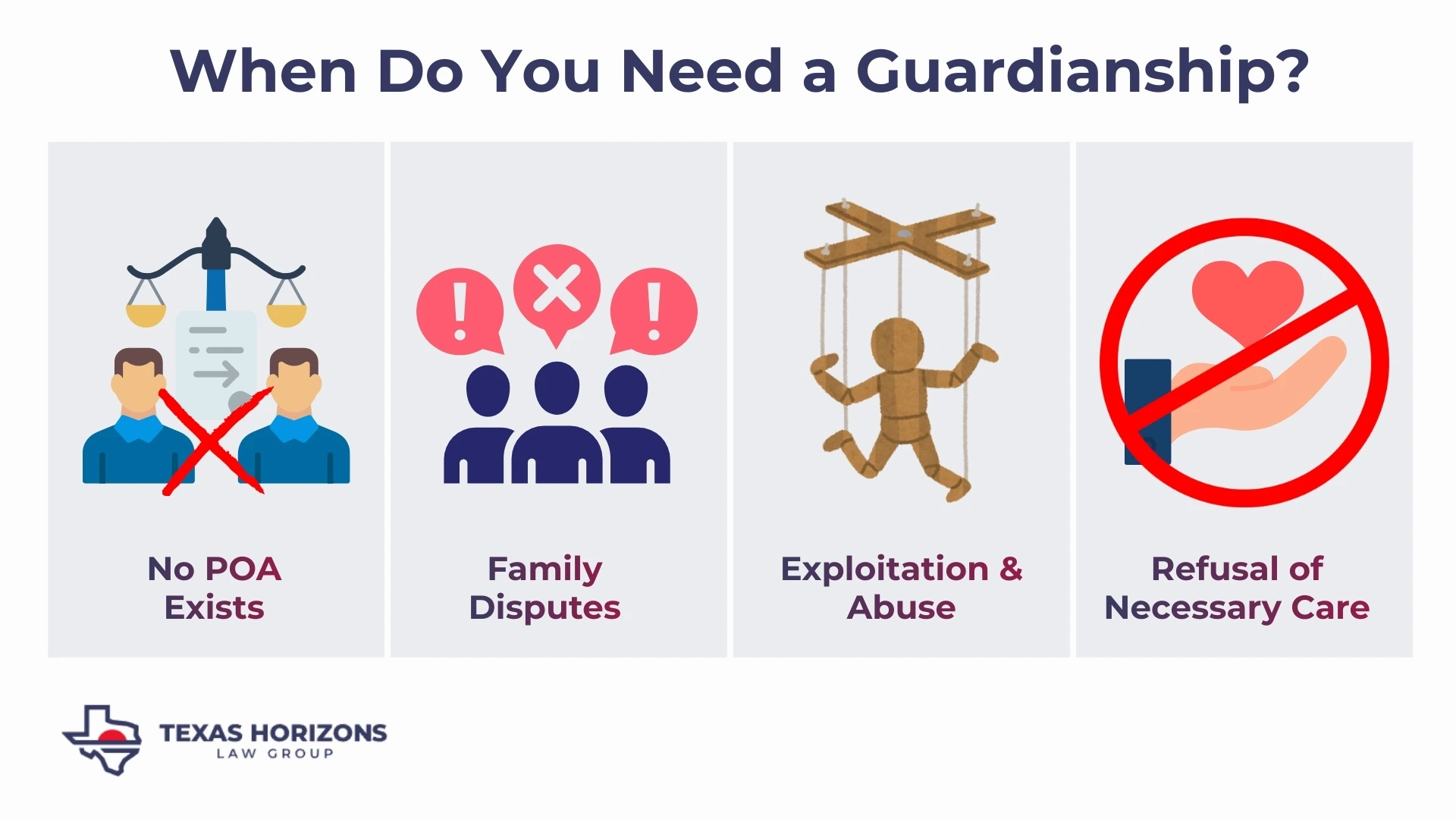
You may need to pursue guardianship if:
- No POA exists: The incapacitated person never signed a POA and can no longer legally sign one.
- Disputes: Family members disagree on who should be in charge, or the agent named in the POA is acting against the principal's best interest.
- Exploitation: The current agent is abusing their power, and court intervention is needed to protect the elderly person.
- Refusal of care: The incapacitated person is refusing necessary medical care or endangering themselves, and a POA agent (who lacks the full authority of a guardian) cannot enforce safety measures.
How to Avoid Guardianship in Texas
The most effective way to avoid court-ordered guardianship is to take action while you are healthy. A complete estate plan should entail the following elements:
- Statutory durable power of attorney: For financial decisions.
- Medical power of attorney: For healthcare decisions.
- HIPAA release: To allow your family to access your medical records.
- Directive to physicians (living will): To state your wishes regarding life support.
- Declaration of guardian: Texas Estates Code §1104.202 allows you to pre-designate who should serve as guardian if a court-appointed guardianship ever becomes necessary. This document informs the court whom you trust to act, and whom you expressly do not want appointed.
Pre-designation reduces family disputes and gives the court a clear direction, rather than leaving the decision to default appointments.
Key Differences of Guardianship vs. Power of Attorney
Both options allow someone to act on another person’s behalf, but they operate under very different conditions. A power of attorney is a planning tool chosen in advance, while guardianship is imposed by the court after capacity is lost or authority is disputed. The differences below illustrate how control, cost, and oversight shift when the court becomes involved.
The choice between these two options often comes down to timing and control. Here is how they compare side-by-side:
A power of attorney works best when capacity remains intact, and authority is respected. Guardianship is used when planning was not done, no longer functions, or conflict prevents effective decision-making.
In cases involving incapacity or disputed authority, guardianship takes priority. The court may override existing powers of attorney to protect the individual’s interests, placing decisions under judicial control with required reporting and oversight.
The Cost Difference Between Power of Attorney and Guardianship
A noteworthy discovery for many families is the significant difference in cost:
- Power of attorney: Typically includes a flat fee for an estate-planning package. It is cost-effective and immediate.
- Guardianship proceedings: Can easily cost between $5,000 and $10,000 just to get started. You must pay for your attorney, the court-appointed attorney for the ward, filing fees, and the cost of posting a bond. Furthermore, the Guardian of the Estate must file detailed annual accountings, which often require hiring an accountant or attorney.
Which Option Should You Choose?
The choice between guardianship and a power of attorney depends largely on the level of control required and whether court involvement is appropriate.
Choose power of attorney if:
- The person still has mental capacity and can choose someone to handle their financial or medical matters.
- You want a private, quick solution without court intervention.
- The person wants to maintain control over the scope of the agent’s powers.
Choose guardianship if:
- The person is incapacitated and can no longer make decisions for themselves.
- There is no valid POA, or if the existing POA agent is unable to act.
- You want court oversight and formal legal authority to manage someone’s care or estate.
- There are family disputes over who should have control, and a court decision is necessary.
- Elder law considerations: Nursing home care in Texas can exceed $7,000 per month. To qualify for Medicaid benefits without draining your savings, your agent needs specific authority to restructure assets.
Can Guardianship Override a Power of Attorney?
Yes. If a court appoints a guardian, that order typically overrides any existing Power of Attorney.
However, if you have a valid Durable Power of Attorney, the court is less likely to grant a guardianship of the estate unless there is a specific reason (like fraud). In fact, the existence of a POA is often used as a defense against an unnecessary guardianship application.
Common Scenarios of This Process:
Questions often arise when routines begin to shift, medical care requires quick action, or financial affairs become harder to manage. These situations vary from household to household, yet several patterns appear frequently across Texas.
Scenario 1: The real estate trap
Your father suffers a severe stroke and needs to move into a skilled nursing facility. To pay for his care, you need to sell his house.
- With a durable POA: You take the document to the title company, sign the deed as his "attorney in fact", and sell the house. The proceeds pay for his care immediately.
- Without a POA: You cannot sell the house. You must hire an elder law attorney, file for Guardianship of the Estate, wait months for a hearing, post a bond, and then get a specific court order permitting the sale.
Scenario 2: The medical emergency
Your spouse is in a car accident and is in a coma.
- With a medical POA: You show the document to doctors and immediately authorize life-saving surgery or access their medical records.
- Without a POA: Texas law allows a spouse to make some decisions under the "next of kin" statute, but if there are disagreements between you and other family members (like adult children from a prior marriage), the doctors may freeze until a guardian is appointed.