Many Texans begin their estate planning with a basic Last Will and Testament. Life rarely stays the same, and a document written years earlier often fails to reflect current wishes. Texas law allows changes to a will, but revisions must meet legal requirements to remain valid. Careful steps help reduce legal challenges and support a smoother probate process.
Texas Horizons Law Group assists clients across South Central Texas with wills, estate planning, and probate. Our work includes advising clients on when a will should be updated, the governing rules, and circumstances that may warrant a new will.
Why Texans Update Their Wills Over Time

A will that matched a person’s goals a decade ago may no longer fit their estate or family needs. Life events can shift financial responsibilities, change family relationships, or introduce new assets. Texas law supports updating a will, but each change must follow the correct legal process.
Many Texans choose to review their wills in the aftermath of significant life changes, which fall into a few key categories:
Family and Relationship Changes
Significant life events often necessitate legal updates to protect personal and financial interests:
- Marriage or remarriage
- Divorce
- Birth or adoption of a child
- Death of a spouse or close family member
- Need to update an executor or guardian
Financial and Asset Changes
Your financial situation is not static. As your income, assets, or liabilities change, it is key to reevaluate your estate planning and guardianship needs:
- Significant financial change (e.g., large inheritance, debt changes)
- Purchase or sale of real estate
- Formation of a business
Health and Location Changes
Health and location changes often arise unexpectedly and can significantly impact one's legal and medical needs. Review legal documents like healthcare powers of attorney and guardianship arrangements to ensure your wishes are respected:
- Health developments affecting long-term plans.
- Relocation in or out of Texas.
These events create new considerations for asset distribution and the family members named in the will. Changes in one's financial situation, for instance, the acquisition of new assets or the assumption of new liabilities, can also motivate an update to one's will. We aim to ensure that these documents are clear, complete, and aligned with your current goals.
Codicil or New Will: Which Approach Fits Your Situation

Texas law recognizes two methods for making changes: a codicil or a completely new will. The choice depends on the size of the adjustment and how much of the existing will still reflects the person’s goals, and choosing the wrong method can lead to legal issues during probate.
Codicil: Targeted Updates to an Existing Will
A codicil is a formal amendment to an existing will. It works best for narrow revisions and adjustments that do not require rewriting the full document.
Common uses for a codicil include:
- Changing an executor or alternate executor.
- Updating a guardian for a minor child.
- Adding or removing a specific gift.
- Making a small wording correction.
- Adjusting a single paragraph that no longer fits.
A codicil must be executed under the same rules as a will. Under Texas Estates Code § 251.051, a typewritten codicil must be signed by the testator in the presence of two credible witnesses, who must also sign. Each codicil should clearly identify the will it modifies and state which sections it replaces. It should also include the self-proving affidavit that is used when a Will is executed in an attorney’s office or under the supervision of attorneys. The original Will and the original of the fully and properly executed codicil should be kept together at all times by the testator. In most cases, drafting a new Will with an estate planning attorney is the better choice to achieve the Testator’s goals and assist in a simplified probate upon the testator’s death. Both the codicil and the Will would have to be filed with the Court upon the testator’s death in the probate.
A New Will: Replacing Older Documents with a Clearer Plan
A new will replaces prior wills and codicils. Texans often choose this path when life changes affect multiple areas of the estate, or when several older documents create confusion.
A new will works well for:
- Blended families
- Second marriages
- Large changes in property or assets
- Business growth or sale
- Death of key beneficiaries
- Situations involving multiple older codicils
Old versions and previous wills must be destroyed or revoked to avoid confusion and ensure that only the new document is recognized as valid.
A new will should include language that revokes all prior wills. Proper execution under Texas Estates Code § 251.001 and § 251.051 helps prevent disputes during probate and gives the court a single, legally binding document to follow.
Handwritten Wills and Key Risks in Texas
Texas allows handwritten, or holographic, wills. The entire document must be written and signed by the testator. Witnesses are not required, but the lack of formalities can cause issues in probate. The common risks associated with this type of work are:
- Missing instructions
- Conflicts with older wills
- Concerns about the testator’s capacity at the time
- Leaving out important language creating unnecessary expenses for family members during the probate
- Disputes among family members
Texas Legal Requirements for Changing a Will
Texas Estates Code sets out specific rules for valid wills and codicils. These rules apply whether a person updates a single paragraph or replaces the entire document.
Key requirements have been identified:
- The testator must be at least 18 years old.
- The testator must have a sound mind.
- The document must express the testator’s intent clearly.
- A typewritten will or codicil must be signed by the testator and two witnesses.
- Each witness should sign in the testator’s presence.
- A holographic will must be entirely in the testator’s handwriting.
These rules help the court confirm the will’s validity and the testator’s intent. Following them reduces the risk of legal challenges, confusion among family members, or delays in probate. Texans who meet the formalities outlined in the Estates Code create stronger, more reliable documents that reflect their current wishes.
Revoking a Prior Will Under Texas Law
Texas Estates Code § 253.002 recognizes several revocation methods:
- Signing a new will that revokes earlier versions.
- Signing a written declaration executed with the same formalities as a will.
- Physically destroying the prior will with the intent to revoke.
Courts rely heavily on clear written revocation language. A new will almost always give the most secure path forward.
Probate Review of Updated Wills
After the testator’s death, the probate court reviews all available documents to determine which will controls. The court examines:
- Whether the will meets Texas legal requirements.
- Whether a newer will exists.
- Whether earlier wills were revoked.
These issues appear in the Texas Estates Code Chapter 256.
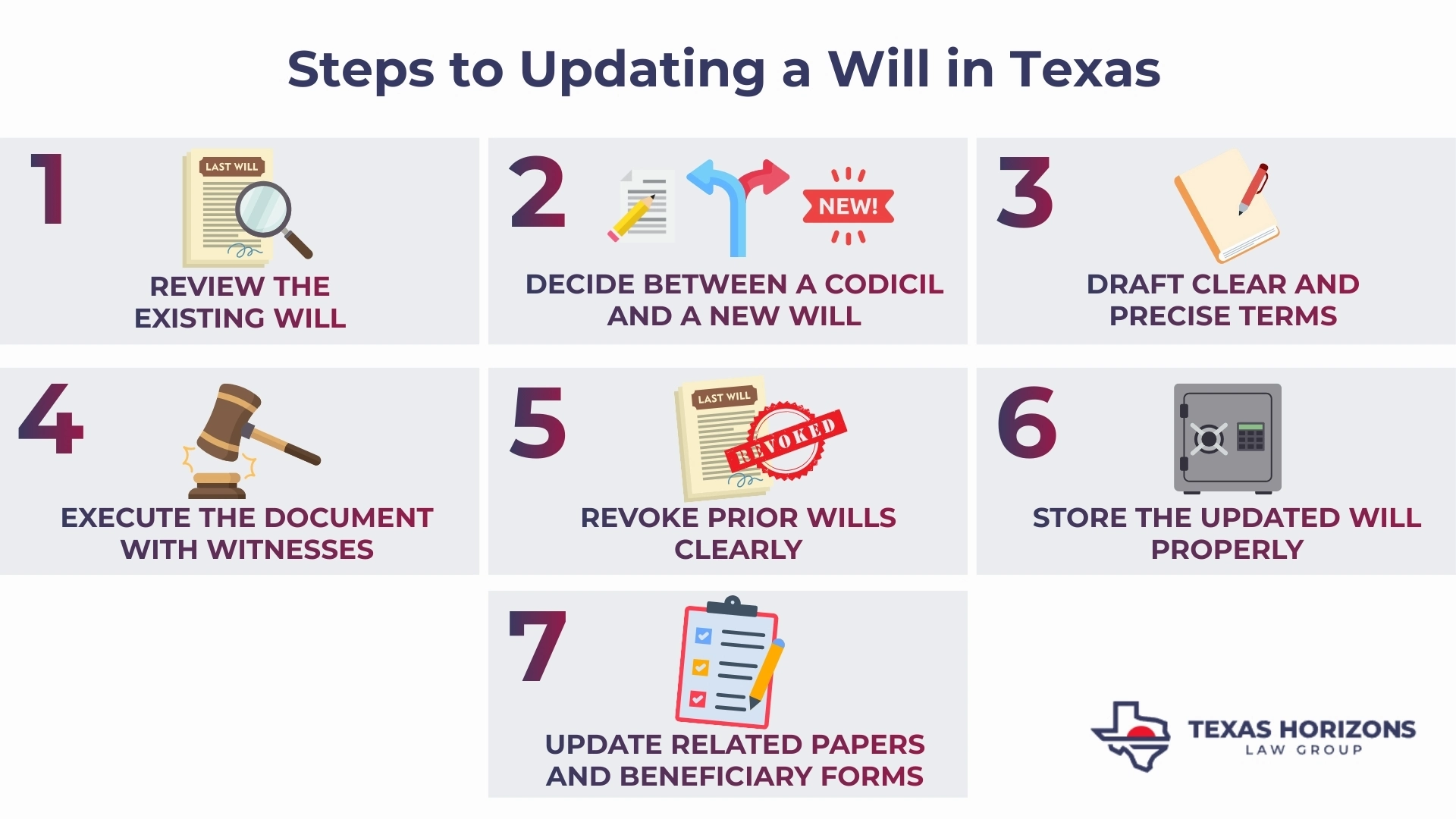
Step-by-Step Process for Changing a Will in Texas

Competitor pages often summarize the update process in a short list. The version below adds Texas-specific detail and key considerations for families in our region.
Step 1: Review the Existing Will
The first step is a careful review of the existing document. The person checks whether:
- Beneficiaries still match current wishes.
- The executor or guardian selection still fits.
- Asset descriptions remain accurate.
- Property listed in the Will still exists.
- The original plan reflects the person’s current life.
This review also evaluates new property or business interests that need inclusion. It also covers any new property or business interests that need to be included.
Step 2: Decide Between a Codicil and a New Will
An experienced estate planning attorney examines factors such as:
- Number of prior wills
- Number of prior codicils
- Family structure
- Size and type of assets
- Risk of conflict among beneficiaries
A codicil may solve a narrow issue. A new will often works better when many updates are needed or when the estate has grown more complex.
Step 3: Draft Clear and Precise Terms
Clear language helps prevent disputes during probate. Ambiguous instructions increase the likelihood of legal challenges. Some areas that might need some clarification are:
- Real estate descriptions
- Specific bequests
- Shares among children or step-children
- Business ownership
- Digital assets
At this stage, additional estate documents may need to be adjusted to keep the overall plan consistent. Topics such as powers of attorney, executor responsibilities, and related probate steps often appear during this review. This approach helps reduce gaps in authority, avoids conflicting terms, and supports a smoother process for family members going forward.
Step 4: Execute the Document with Proper Parties Present

Texas requires two credible witnesses for typewritten wills and codicils, and for purposes of the self-proving affidavit, a notary must also be present. Key points about witnesses include:
- At least fourteen years of age.
- Able to understand the act observed.
- Not beneficiaries or executors named in the Will.
- Executed outside of presence of beneficiaries or executors named in the Will.
- Should have a self-proving affidavit which requires a notary present at time of signing to reduce or eliminate the need of witness testimony at the probate hearing.
- Proper signing of the Will in accordance with the Texas Estates Code, often called the “Will Signing Ceremony”.
These steps help protect the will’s validity and support the document if questions arise.
Step 5: Revoke Prior Wills Clearly
A new will must contain language that cancels any earlier documents. A straightforward clause is often used to show this intent, for example: “I revoke all prior wills and codicils”.
This type of statement helps the court identify the most recent document as the controlling document for asset distribution. When a person chooses to use a codicil instead of a new will, the codicil must state which parts of the original will it changes so the final plan remains clear and free of conflicting terms.
Step 6: Store the Updated Will Properly
Safe and consistent storage prevents disputes. Common practices include:
- Keeping the signed original in a secure home safe.
- Informing the executor of its location.
- Destroying or marking prior versions as revoked.
- Avoiding multiple signed copies stored in different places.
Correct storage helps ensure that family members, the executor, and the probate court can identify the updated will without confusion. Clear access to the most recent document supports a smoother probate process and reduces the chance of disagreements among beneficiaries.
Step 7: Update Related Papers and Beneficiary Forms
Changes in the will may require updates to:
- Life insurance beneficiary designations
- Retirement account forms
- Property titles and deeds
- Business agreements
- Medical and durable powers of attorney
A review of these items helps ensure the broader plan stays consistent. Some situations may require attention to matters related to other estate planning documents, such as revisions to a power of attorney.
Notifying Beneficiaries and Executors After a Will Change
Once an updated will is completed, communication with the people involved in your estate plan can help provide a clearer path forward. Texas law does not require you to notify beneficiaries or executors during your lifetime, but many families choose to do so to reduce confusion and limit the chance of disputes.
Examples include:
- A new appointment as executor or co-executor.
- A change in the order of successor executors.
- Adjusted asset distribution instructions.
- New property that requires management or oversight.
Beneficiaries may also benefit from awareness of significant changes. Clear communication can help avoid tension among family members, particularly when the updated will modify a prior inheritance plan.
Some Texans share a copy of the updated will with the executor or with close family members. Others share a summary of the main changes instead. Either approach helps the people involved understand your intentions and supports a smoother probate process when the time comes.
Common Mistakes Texans Face When Changing a Will
Many probate disputes begin with errors made during the update process. Some common problems are listed below:
- Writing notes on the old will instead of executing a formal update.
- Using vague terms that lack legal clarity.
- Leaving out changes to guardianship for a minor child.
- Naming an executor who can no longer serve.
- Conflicting language across prior wills.
- Creating handwritten updates that do not meet legal requirements.
- Forgetting to revise digital asset access.
- Keeping several signed versions in different locations.
- Failing to update beneficiary forms on accounts.
These issues can lead to disputes, delays, or unexpected results.
Special Situations That Require Additional Care

Certain circumstances create additional considerations when updating a will. These situations often involve multiple layers of family relationships, property interests, or long-term responsibilities.
Blended Families
Second marriages and blended families often involve multiple beneficiaries with different expectations. Estate plans from earlier marriages may create conflict if not updated. A detailed review helps ensure each family member’s role remains clear.
Ranch Property, Land, and Investment Real Estate
Large property holdings often require added attention during a will update. Families with ranch land, multiple parcels, or investment properties may need to revise both the will and the documents connected to those assets. Changes in ownership, new acquisitions, or the sale of property can affect how the estate passes through probate.
In some cases, the update may also involve reviewing deeds, title structures, and related instruments such as specialized property deeds or a deed of trust.
Health-Related Planning
Significant medical developments often lead to updates in:
- Medical power of attorney
- Durable power of attorney
- Emergency decision-making instructions
Coordinating these documents reduces gaps in authority and supports smoother long-term planning.
How an Estate Planning Attorney Can Support You
Some wills require only small adjustments, while others require complete rebuilding. An estate planning attorney helps ensure that each change meets Texas legal requirements and fits the person’s estate planning needs.
An attorney’s support typically includes:
- Reviewing all prior wills.
- Identifying conflicts and legal risks.
- Drafting clear and precise terms.
- Ensuring compliance with the Texas Estates Code.
- Coordinating wills with property records and beneficiary forms.
- Reducing confusion among family members.
Each estate carries its own mix of property and family responsibilities. A tailored plan helps protect the estate and avoid misunderstandings.