When a person dies with a trust in place, the trust does not die with them. It remains a separate legal entity that holds and manages assets for the trust beneficiaries. For many Texas families, a trust is a popular estate planning tool that can help avoid probate for certain assets, protect assets for children, and keep family finances private.
Below, our team at Texas Horizons Law Group explains how a trust works under Texas law after someone dies, how the successor trustee steps in, and what to expect regarding debts, taxes, and asset distribution. Our team of experienced Texas estate planning and probate attorneys serves clients throughout Seguin, New Braunfels, and surrounding counties.
What Is a Trust in Texas?

Under the Texas Trust Code, a trust is a legal arrangement where one person (the trustee) holds and manages property for others (the beneficiaries) under terms set by the person who created the trust (the grantor or settlor).
A trust is made up of key parts:
- Trust document that sets out the terms of the trust.
- Trust assets such as real estate, bank accounts, investments, and other property.
- Trustee who manages those assets.
- Beneficiaries who will receive trust funds or property.
During the grantor's lifetime, the grantor typically retains control over the trust and its assets and can modify or revoke the trust as needed. As long as assets are correctly titled in the name of the trust, the trust owns those assets, not the individual person. This is why a trust can continue after the grantor’s death.
What Happens upon the Grantor’s Death?
When the grantor dies:
- A revocable living trust usually becomes an irrevocable trust; the terms can no longer be changed, and the trust remains in place under the written instructions.
- The successor trustee named in the trust document steps into the trustee’s role and takes legal control of the trust property.
- The trust administration phase begins, which involves managing the assets, settling debts and taxes, and distributing assets to beneficiaries in accordance with the trust's terms.
In short, the trust remains open as a separate entity, the trust typically becomes irrevocable, and the successor trustee takes over management of the trust assets to make sure the grantor’s wishes are carried out. In Texas, this process allows property to be distributed without probate in most cases.
Revocable Trust vs. Irrevocable Trust After Death
Many Texas families hear terms like "revocable living trust" and "irrevocable trust" and question the implications of each following a person's death.
Revocable Trust During Life vs. After Death
During the grantor’s lifetime, a revocable trust (often called a living trust) is flexible: the grantor can change the terms, add or remove assets, or revoke the trust. After the grantor dies, the revocable trust usually:
- Locks in its terms and becomes irrevocable.
- Keeps ownership of the assets held in the trust.
- Operates under the instructions written before death.
Irrevocable Trust After Death
An irrevocable trust is already fixed while the grantor is alive. After the grantor passes, the trust:
- Continues under the same terms unless a court or the Texas Trust Code allows modification or termination.
- May offer asset protection and potential tax benefits, depending on how it was set up.
Irrevocable trusts may also provide tax savings due to their separate legal and tax status.
The main difference is control — revocable trusts can be changed during someone's lifetime. On the other hand, irrevocable trusts cannot be altered, but may be better for planning reasons. In both cases, the successor trustee steps in to manage the assets and follow the terms of the trust.
What the Successor Trustee Must Do After the Grantor’s Death in Texas

Most explanations of the trust-settlement process focus on one central point: that the successor trustee must assume administrative duties promptly.
Texas law sets out a comparable series of steps:
Step 1: Confirm the Death and Locate the Trust Documents
The successor trustee usually:
- Obtains several death certificates from the county or funeral home.
- Locates the original trust document, plus any amendments or restatements.
- Confirms that they are the successor trustee named in the trust.
These documents will be needed for banks, title companies, and others before they will accept the successor trustee’s authority.
Step 2: Accept the Trustee’s Role and Review the Trust
Once the successor trustee steps into the role, they should:
- Read the trust document carefully to understand the terms of the trust.
- Identify the current trust beneficiaries.
- Note any special instructions, such as holding trust funds for minor children until they reach a certain age.
The trustee’s fiduciary duty begins as soon as they assume the role. That duty includes loyalty, prudence, and fairness toward the beneficiaries under the Texas Trust Code.
Step 3: Identify and Secure Trust Assets

The trustee then moves to gather and secure assets held in the trust, such as:
- Bank accounts titled in the name of the trust.
- Real estate where the deed lists the trust as owner.
- Investment accounts or brokerage accounts.
- Business interests or rental properties.
The trustee may need to open a new trust bank account or update titles to reflect that the successor trustee now manages the trust.
Step 4: Communicate with Trust Beneficiaries
Good communication helps avoid disputes. The trustee should:
- Notify beneficiaries that the grantor has died and that the trustee is now in charge.
- Share basic information about the trust administration timeline.
- Explain what information beneficiaries can expect to receive, such as accountings or summaries of assets.
Texas law gives beneficiaries certain rights to information about the trust, and failing to respect those rights can lead to legal issues for the trustee.
Step 5: Handle Outstanding Debts, Taxes, and Ongoing Bills
Even when assets are in a trust rather than a probate estate, there are still:
- Outstanding debts that may need to be paid.
- Final federal income tax returns and any trust income tax returns.
- Property taxes on real estate and other administration expenses.
Texas has no state estate or inheritance tax, so most tax questions relate to federal estate tax, income tax, and capital gains tax. For large estates, tax planning can be complex and may require guidance from both an estate planning attorney and a tax professional.
Step 6: Distribute Remaining Assets
After settling debts and taxes, the trustee focuses on asset distribution:
- Some beneficiaries may receive lump-sum payments.
- Others may receive ongoing trust funds for education, support, or special needs.
- Certain assets may be held for beneficiaries until they reach a certain age or meet specific conditions.
The trustee must comply with the trust's written terms. Deviating from those terms can count as a breach of fiduciary duty.
How Trust Assets Relate to Probate in Texas
One major reason families use living trusts is the ability to avoid probate for assets held in the trust. Under Texas law, property titled in the trust's name is generally not part of the probate estate and is handled through trust administration rather than a probate proceeding.
The probate process is a court-supervised procedure for distributing assets that are not held in a trust. Trusts are often used specifically to avoid the probate process and its associated delays and costs.
However, many estates have a mix of assets:
- Assets held in the trust are handled by the trustee.
- Assets in the decedent’s name alone usually require probate or, for small estates, alternatives like a small estate affidavit.
Even when a trust is present, there are many cases where a will still needs to be probated, especially to handle assets that were never retitled into the trust.
How Different Assets in a Trust Are Handled After Death
The trust’s terms and state law govern how each asset category is managed and distributed.
Common examples include:
- Bank accounts and investment accounts that are titled in the name of the trust.
- Real estate such as the family home, rental property, or ranch land.
- Business interests like shares in an LLC or partnership.
- Life insurance or retirement accounts that name the trust as beneficiary.
The trustee’s job is to manage and transfer assets to beneficiaries according to the terms of the trust, and to keep clear records of what happens with each asset.
Tax Considerations: What Trustees and Families Should Know

Although Texas does not impose its own estate or inheritance tax, federal rules still apply for larger estates or trusts. Issues that often arise include:
- Income tax on earnings generated by trust investments after the grantor’s death.
- Potential capital gains tax when the trust sells real estate or other assets.
- Ongoing property taxes on Texas real estate.
Many high-net-worth families use trusts as part of a broader estate planning strategy to protect assets and reduce potential estate taxes.
What If the Trustee Dies, Resigns, or Refuses to Serve?
Sometimes the person named as initial trustee or successor trustee dies, becomes incapacitated, or simply cannot serve. Good trust planning usually addresses this with:
- One or more alternate successor trustees listed in the trust provisions.
- Procedures for beneficiaries to appoint a new trustee.
- Authority for a court to appoint a trustee if the document is silent.
If both the initial trustee and the successor trustee named in the document are unable to serve, beneficiaries or other interested parties may need to ask a Texas court to appoint a new trustee under the Texas Trust Property Code.
This is one reason a properly drafted trust often names more than one successor trustee or gives a trusted person the power to name a replacement.
Key Benefits of a Trust After Death in Texas
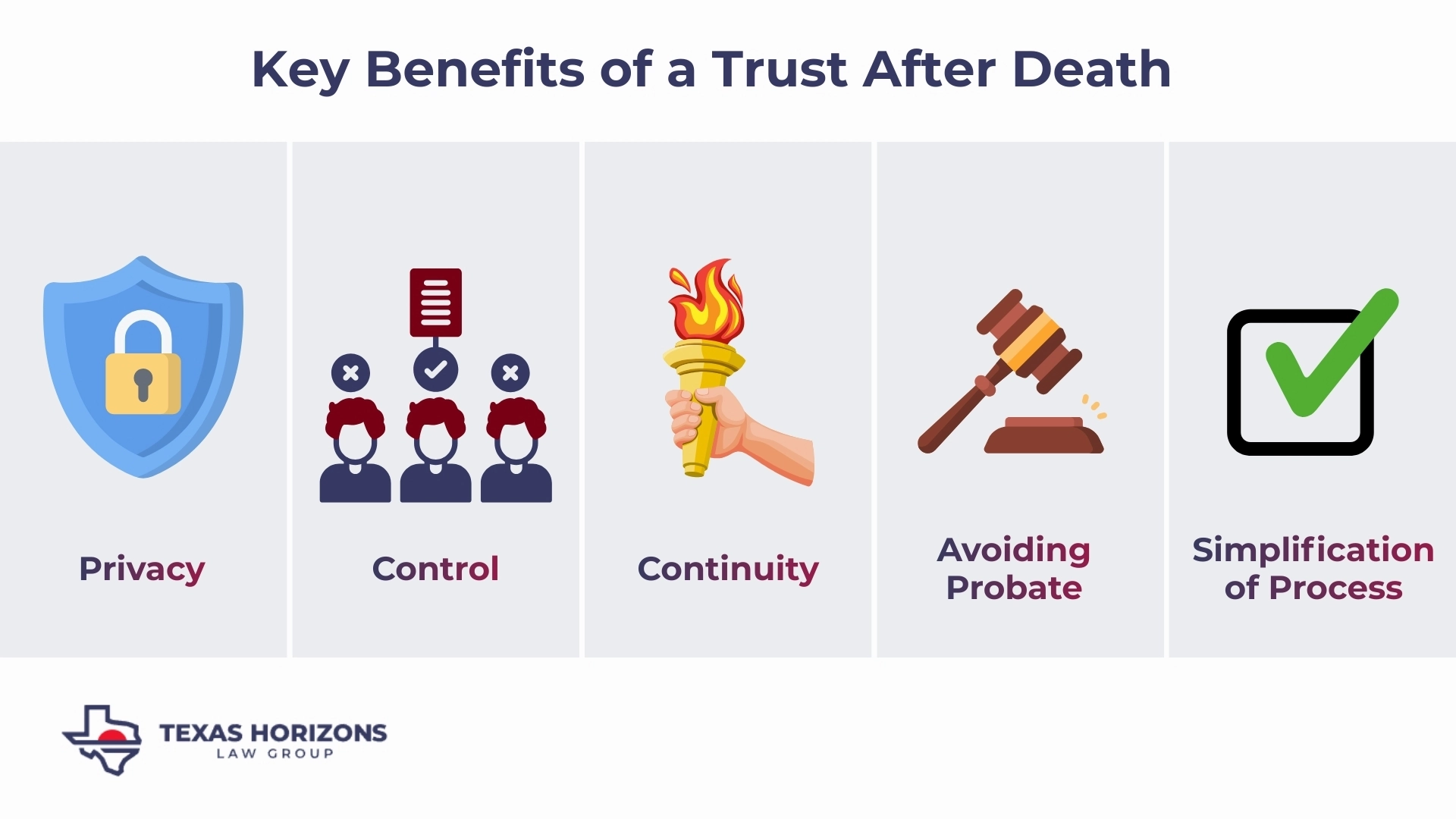
There are several recurring benefits that a trust offers after the grantor’s death. For Texas residents, these often include:
- Avoiding full probate for assets held in the trust can simplify the legal process.
- Privacy, because trust administration is handled outside the public probate court record.
- Control over asset distribution, such as support for minor children, spendthrift beneficiaries, or family members with disabilities.
- Continuity, because the successor trustee steps into the role without waiting for a court appointment.
Trusts are one tool among many in estate planning. For some families, a will, transfer-on-death deeds, or beneficiary designations may achieve similar goals; for others, a living trust is central to protecting assets and giving clear instructions.
Practical Examples of Trust Administration After Death for Texas Families
To make the process more concrete, consider a few common scenarios.
Example 1: Married Couple with a Revocable Living Trust
A couple in Seguin creates a revocable living trust during the grantor’s lifetime and transfers their home, bank accounts, and non-retirement investments into the trust. When the first spouse dies:
- The surviving spouse continues as trustee.
- The trust property remains in the trust.
- No probate is needed for the assets already in the trust.
When the second spouse dies:
- A successor trustee named in the document takes control.
- The trustee settles debts and taxes, then distributes the remaining assets to the children in accordance with the trust’s instructions.
Example 2: Single Parent with Minor Children
A single parent with minor children creates a trust that:
- Holds life insurance proceeds and investment accounts for the children.
- Names a trusted sibling as successor trustee.
- Directs the trustee to use trust funds for the children’s support, education, and medical needs until they reach a certain age.
When the parent dies, the trust remains open for years, and the successor trustee manages the trust assets until the children are old enough to manage their own money.
Other Tasks After Death: Social Security and Non-Trust Issues

Even when a trust handles most of the person’s assets, families still have other steps to take.
Notifying Social Security After a Death: What to Do
If the person received Social Security or Medicare, the Social Security Administration (SSA) must be notified of the person's death. Often, the funeral home reports the death; if not, a family member can call SSA or visit a local office. Any Social Security payments issued for the month of death or later may need to be returned.
What Happens to Assets Not in the Trust?
The trust does not automatically control everything. The family may still need to handle:
- Vehicles, personal items, or accounts still in the decedent’s name.
- Life insurance or retirement accounts with individual beneficiaries.
- Real estate or mineral interests that were never retitled into the trust.
These items may require probate, a small estate affidavit, or other solutions under Texas law.
Does a Living Trust Survive Death?
The answer is yes — a living trust does survive the grantor’s death.
Once the grantor dies, the trust often becomes irrevocable, meaning its terms can no longer be changed. At that point, the successor trustee named in the document assumes full authority to manage and distribute the trust assets.
This role includes paying final expenses, handling tax matters, and distributing property to beneficiaries as directed by the trust. Because the trust remains a separate legal entity, it avoids probate and allows a smoother transfer of assets.