Yes, you can sell a house in a trust in Texas. The trustee may complete the sale if the trust document authorizes it and if legal requirements are followed. Whether the property is held in a revocable, irrevocable, or testamentary trust, the trustee must confirm authority, meet fiduciary duty obligations, address tax implications, and ensure the sale complies with Texas law.
If you are preparing to sell trust property, this guide explains the complete process in a clear, practical way. Our Texas real estate attorneys at Texas Horizons Law Group help trustees and families across Texas with trust property sales and can support you at any stage.
What Is a Trust When It Comes to Real Estate?

A trust is a legal arrangement used to manage assets such as a family home, rental property, land, or other real estate. Many Texans place a house in a trust to protect property, simplify estate administration, avoid the probate process, or ensure that real estate transfers ownership smoothly after the grantor passes. When a home becomes trust property, decisions about selling the house must comply with the trust agreement and the legal obligations imposed on the trustee.
If you are selling a property that you own, there are a few key considerations to keep in mind. A residence can be sold in one of two ways: either as an ordinary sale or through a trust. The sale of a house held in a trust is similar to a traditional home sale, but a few additional factors require close attention.
Revocable Trusts (Revocable Living Trusts Used for Homes)
A revocable trust allows the grantor to retain control of real estate during the grantor’s lifetime. The grantor may buy, sell, refinance, or manage property held in the trust. A house in a trust of this type can be sold much like any typical home sale, since the grantor retains control and usually serves as trustee. After the grantor dies, the trust becomes irrevocable, and the successor trustee assumes responsibility for the home sale, asset distribution, and legal compliance. The Texas Estates Code recognizes revocable living trusts as valid estate-planning tools, and many real estate transfers into these trusts follow Texas Property Code Title 2 rules.
Irrevocable Trusts That Hold Texas Homes
An irrevocable trust removes the home or real estate from the grantor’s ownership and places control with the trustee. This type of trust may offer asset protection or tax advantages, but selling a house in an irrevocable trust requires following the strict terms of the trust agreement. The trustee must consider beneficiaries’ interests, limitations on real estate transfers, and potential tax implications. Some irrevocable trusts require beneficiaries' consent before the house may be sold. Irrevocable trust rules are outlined under Texas Trust Code Chapter 112, which governs the creation and management of trusts in the state.
Testamentary Trusts
A testamentary trust is created during probate and often holds real estate inherited under a will. Testamentary trusts are managed under Texas Estates Code Chapters 101–123, which control how assets move through probate. The successor trustee manages the house in accordance with the instructions in the will.
Who Has the Authority to Sell Trust Property in Texas

Only the trustee has legal authority to sell trust property. The trustee must comply with the trust agreement and ensure legal compliance throughout the selling process. Failure to follow these rules may create legal issues, tax liabilities, or disputes with beneficiaries.
How Trustee Authority Works
The trust agreement must explicitly give the trustee the authority to:
- Manage assets
- List and sell trust property
- Distribute sale proceeds
- Sign legal documents related to the sale
The trustee must review trust documents to confirm whether they may sell trust property and whether beneficiary consent is required. When the grantor retains control in a revocable trust, the grantor usually acts as trustee until the grantor dies or becomes unable to serve. If the grantor retains control during a revocable trust, the grantor typically acts as trustee until the grantor passes.
Successor Trustee Responsibilities
When the grantor dies, a successor trustee takes over. Title companies need documentation showing the legal authority to act on behalf of the person, such as trust certifications, death certificates, trust documents, and trustee ID.
Fiduciary Duty Requirements
Trustees must act in beneficiaries’ best interests, which includes:
- Obtaining fair market value for trust-owned property
- Managing trust assets responsibly
- Keeping trust records accurate
- Avoiding personal benefit
- Ensuring legal compliance at each step
Because trustees bear personal responsibility for mistakes, many seek legal guidance before selling a house in a trust.
Step-by-Step: How to Sell a House in a Trust in Texas
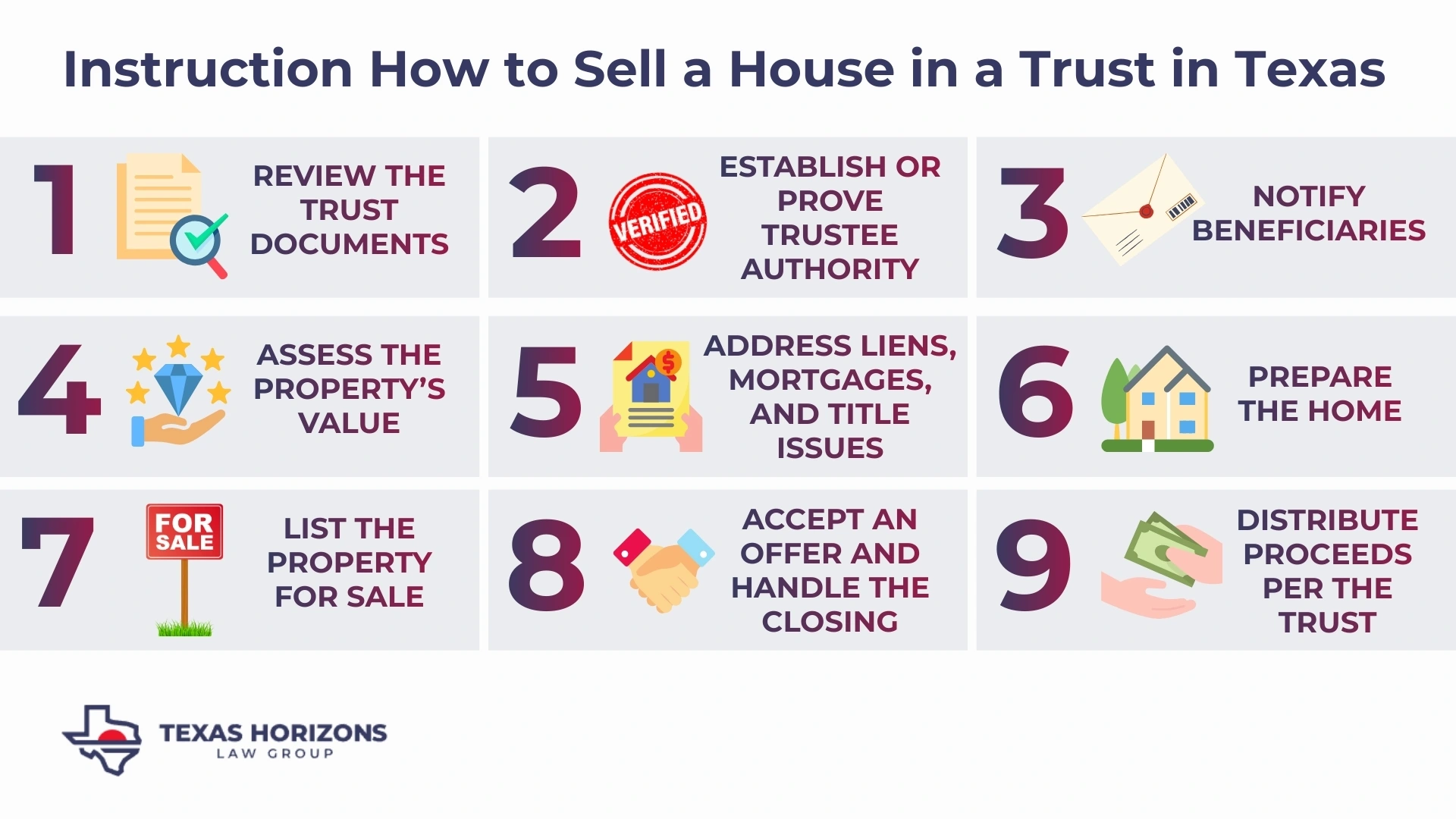
Selling a house that's held in a trust in Texas can be challenging due to the state's unique real estate laws. However, with the right knowledge and approach, this process can be manageable. The following steps provide a comprehensive overview of the trust selling process:
Step 1: Review the Trust Documents
The trust agreement defines everything the trustee must do. The first step is to read the trust documents to confirm:
- Authority to sell the home
- Requirements for notifying beneficiaries
- Instructions about distributing sale proceeds
- Restrictions involving multiple beneficiaries
When selling a trust, it is vital to meticulously review the trust document to ensure compliance and prevent any potential issues. This means that mistakes are avoided and the sale is actually in line with what the grantor wanted. Selling trust-owned property can be legally complex (e.g., multiple beneficiaries, title issues, trust documents) and often requires an attorney’s help.
Step 2: Establish or Prove Trustee Authority

The title company requires documents showing legal authority. These may include:
- Trust certification
- The full trust document
- Successor trustee acceptance
- A death certificate if the grantor dies
- Government-issued identification
Without these documents, the sale cannot proceed because the title company must confirm that the trustee is legally permitted to sign the trustee’s deed.
Step 3: Notify Beneficiaries (If Applicable)
Trust sales often involve more than one person. Some trust agreements require the beneficiaries to agree to sell property. Even when it's not necessary, letting the beneficiaries know can help avoid any problems, especially when more than one person inherits a house. It's advisable to maintain transparent communication throughout the sales process to ensure clarity and prevent any potential misinterpretations.
Step 4: Assess the Property’s Value
The trustee must determine fair market value to meet fiduciary duty standards. Options include:
- A comparative market analysis prepared by a real estate agent.
- A formal appraisal completed by a licensed appraiser.
- Consultation with a real estate professional familiar with home sales in your area.
The fair market value affects capital gains tax, tax implications, and how the money from the sale is distributed.
Step 5: Address Liens, Mortgages, and Title Issues

Before listing the home, confirm:
- Mortgage payoff amounts
- Unpaid property taxes
- Homeowner association obligations
- Liens or judgments
- Title issues affecting transfers of ownership
- Validity of insurance coverage
The title company just needs to clear everything up first, then they'll get the legal documents ready. If these issues are addressed at the outset, they will not require further attention later on.
Step 6: Prepare the Home (Repairs or “As-Is”?)
The trustee must decide whether to repair the home or sell it as-is. Factors include:
- Available trust assets
- Current condition
- Realistic return on improvements
- Beneficiaries’ expectations
- Tax implications for capital gains taxes
What does “as-is” mean?
Selling a home as-is means the property is sold in its current condition, with no obligation for the trustee to make repairs or offer credits for defects discovered during inspection. The trustee must still disclose known material defects, but buyers accept the risk and responsibility for future repairs. An as-is sale can reduce costs and speed up the transaction, particularly when repairs would not meaningfully increase the sale price.
A real estate agent may recommend updates that increase fair market value, or an as-is approach if repairs do not provide a strong return.
Step 7: List the Property for Sale

The trustee signs a listing agreement with a real estate agent. The agent shows the property to potential buyers, schedules viewings, and negotiates offers. In trust sales, the listing will typically state that the property is trust-owned. Prior experience with trust sales is advantageous, as it entails more paperwork.
Step 8: Accept an Offer and Handle the Closing
Once an offer is accepted, the trustee signs the purchase agreement. Trust certification and other trust documents must be provided before the sale occurs.
During closing:
- The title company prepares legal documents
- The escrow company manages funds
- The trustee signs a trustee’s deed
- The property transfers ownership to the buyer
- Sale proceeds are deposited into the trust
Step 9: Distribute Proceeds per the Trust
After closing:
- Sale proceeds must be held as trust assets
- The trustee may pay tax obligations
- The trustee distributes assets according to the trust document
- An accounting may be provided to beneficiaries
Proper distribution ensures the trustee meets all legal obligations and honors the grantor’s wishes.
Texas-Specific Laws and Tax Implications
Trustees selling property in Texas must account for state-specific trust and tax laws, as well as the requirements tied to estate planning and probate services, before completing a sale.
Probate and Trusts
Revocable trusts often avoid probate court altogether. Testamentary trusts, created by wills, begin after probate and may involve court supervision.
Estate Taxes and Inheritance Tax
Texas does not impose:
- A state inheritance tax
- A state estate tax
Federal estate tax may apply only when an estate exceeds federal limits.
Capital Gains Tax and Stepped Up Basis

Capital gains tax may apply when selling trust property. Tax professionals consider:
- Whether the property receives a stepped-up basis when the grantor dies.
- Whether the home was sold during the grantor’s lifetime.
- How do trust tax rate levels compare to individual tax rates.
For example, when a grantor dies, the home often receives a stepped-up basis equal to fair market value on the date of the grantor’s death. This reduces capital gains tax when a house is sold in a trust soon after the grantor's death.
The trust could face increased capital gains tax liability if it lacks a stepped-up basis. Irrevocable trusts can have substantial tax implications, as they often result in higher tax rates. If you are dealing with capital gains tax, it is advisable to consult a tax professional. A tax professional can assist you in determining your tax liability, identify any potential tax benefits, and provide a comprehensive understanding of the situation.
Tax Liabilities for Trusts
Irrevocable trusts often face higher tax liabilities. A tax professional can help trustees understand:
- How to pay tax on gains
- Whether to distribute gains to beneficiaries
- How tax advantages apply
- Whether the trust or the beneficiaries should report the capital gain
Trustees often seek legal guidance to review tax implications before dividing sale proceeds.
Tips for a Smooth Trust Home Sale in Texas
Here are helpful steps to support a successful property sale in Texas:
- Review trust documents closely
- Maintain clear records
- Communicate openly with beneficiaries
- Work with a real estate agent familiar with trust sales
- Handle title issues early
- Meet all fiduciary duty requirements
- Separate trust funds from personal funds
- Review tax implications with a tax professional
- Consult a law firm for legal guidance when needed
These steps help protect both the trustee and beneficiaries.