Commercial space in Texas can be leased under a wide range of structures, each of which allocates costs and responsibilities differently depending on the property type and use. An office tenant may face a very different financial arrangement than a retail or industrial tenant occupying similar square footage.
These distinctions are often reviewed with New Braunfels real estate attorneys when businesses or landlords evaluate lease obligations before execution. Texas Horizons Law Group assists commercial property owners and tenants across Texas with lease structures affecting expense allocation and contractual risk.
What Makes Commercial Leases Different from Residential Leases
Commercial leases operate under a contractual framework that differs substantially from residential leasing in Texas. Statutory protections for residential tenants are limited in commercial settings, placing greater emphasis on negotiated terms.
Commercial lease agreements often address far more than rent and duration. Taxes, insurance, utilities, maintenance costs, and security obligations are commonly allocated by contract rather than statute.
Several distinctions separate commercial leases from residential leases:
- Residential leases are governed by Texas Property Code Chapter 92.
- Commercial leases rely largely on contract law rather than tenant-protection statutes, but many Texas Property Code provisions still apply.
- Expense allocation is controlled almost entirely by lease language.
These differences explain why commercial lease drafting carries long-term financial consequences.
The Three Main Types of Commercial Leases
Most commercial real estate leases in Texas fall into three primary categories. Each category assigns costs differently between landlord and tenant and serves distinct property uses.
The three main types include:
- Gross lease
- Net lease
- Modified gross lease
Additional variations appear within these categories depending on property type, tenant use, and market conditions.
Common patterns by property type include:
- Office space: Gross leases and modified gross leases appear most often, particularly in multi-tenant office buildings where centralized management controls utilities, maintenance, and security.
- Retail spaces: Triple-net and percentage leases are widely used, especially in shopping centers and standalone retail buildings, where tenants control their space and sales volume.
- Industrial properties: Triple-net and double-net leases are common, reflecting lower shared maintenance costs and longer lease terms tied to equipment or logistics operations.
While these patterns are common, Texas commercial leases remain contract-driven. Lease language, not property type alone, determines final responsibility.
Gross Lease
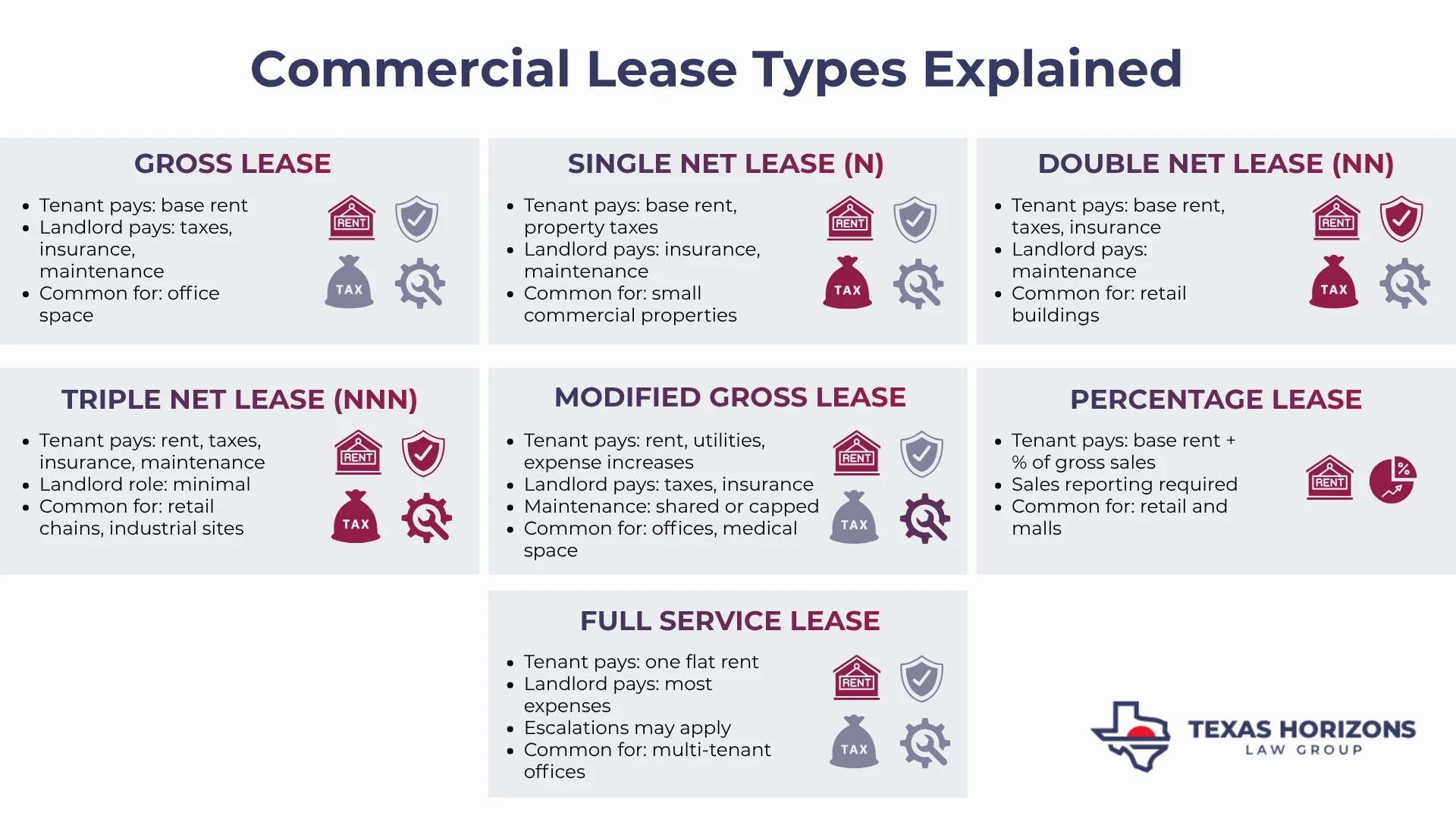
A gross lease places most property-related expenses on the landlord. The tenant pays a fixed rent, often structured as a single annual fee or a monthly base rent. This lease type is common in office buildings, where predictable monthly costs support business planning.
Under a typical gross lease, expense allocation follows a standard pattern.
- Property taxes paid by the landlord, based on county appraisal district assessments (as Texas has no state property tax).
- Building insurance remains a landlord obligation.
- Maintenance and common-area costs are included in the rent.
Tenants may still pay utilities such as electricity if the lease assigns those costs separately. Gross leases reduce expense variability for tenants, while landlords price rent to reflect anticipated operating costs.
Net Lease
A net lease transfers one or more operating expenses from the landlord to the tenant. Texas commercial real estate commonly uses net lease structures for retail spaces and freestanding buildings.
Net leases come in three primary forms, each increasing the tenant's responsibility.
Single Net Lease (N Lease)
Although less common, a single net lease requires the tenant to pay base rent plus one additional expense, most often property taxes. Insurance and maintenance are usually the landlord's responsibility unless the lease states otherwise.
Expense allocation under this lease type is straightforward:
- Tenant pays base rent
- Tenant pays property taxes assessed by local appraisal districts
Property tax obligations are governed by the Texas Tax Code and are based on county appraisal valuations. Single-net leases are rarely used but may be appropriate for smaller commercial properties or transitional leasing arrangements.
Double Net Lease (NN Lease)

A double net lease expands tenant responsibility by adding insurance costs to property taxes. Maintenance duties may still be set out in the lease between the tenant and landlord, as some agreements assign limited repair obligations to the tenant.
Cost allocation under a double net lease generally includes:
- Base rent paid by the tenant
- Property taxes paid by the tenant
- Property insurance premiums are paid by the tenant
Double-net leases are common in retail buildings and smaller shopping centers, where cost-sharing reduces the landlord's exposure.
Triple Net Lease (NNN Lease)
A triple-net (NNN) lease places nearly all operating expenses on the tenant. This structure is widely used throughout Texas commercial real estate markets.
After lease execution, landlord involvement is typically limited. Tenant responsibilities usually include:
- Base rent
- Property taxes
- Insurance
- Maintenance costs
- Pro rata share of common area expenses
Property tax rates published by the local or municipal government of the County where property is located and/or the Central Appraisal District of the County where property is located, and insurance premium increases directly affect tenant costs. Triple net leases are frequently used for national retailers, industrial properties, and long-term investment holdings.
Modified Gross Lease (MG Lease)
A modified gross lease combines elements of gross and net leases. This structure allows cost sharing based on negotiated terms rather than a fixed model. Modified gross leases are frequently used in office and medical space across Texas.
Expense allocation often follows this pattern:
- Tenant pays base rent and utilities
- Landlord pays property taxes and insurance
- Maintenance costs are shared or capped
Many modified gross leases rely on a base-year calculation, in which the landlord estimates operating expenses for a reference year, and the tenants pay increases above that amount.
Percentage Lease
A percentage lease ties rent to business performance and is primarily used in retail environments. Part of the rent is based on gross sales rather than a fixed amount.
Rent obligations under this structure include:
- Base rent
- A percentage of gross sales above a defined threshold
Texas percentage leases often include audit provisions to verify reported sales figures. These clauses affect the accuracy of rent and enforcement rights.
Full Service Lease

A full-service lease resembles a gross lease but may include structured expense caps or annual adjustments. This format is common in multi-tenant office buildings.
Typical characteristics include:
- One flat annual fee or fixed rent
- Landlord pays most operating expenses
- Escalation clauses tied to expense increases
Tenants should review adjustment provisions carefully, especially those tied to tax reassessments or changes in insurance premiums.
Comparing Common Commercial Lease Types in Texas
Texas commercial leases rely on contract terms rather than statutory defaults. Lease type affects more than base rent. Taxes, insurance, and maintenance may account for 20% to 40% of total annual occupancy costs, particularly under net and triple-net arrangements.
The table below summarizes how responsibility is typically allocated across common commercial lease types:
While this table reflects common practice, actual responsibility depends on lease language. Texas courts generally enforce commercial lease terms as written, even when expense allocation shifts substantial cost to one party.
For example, a 10,000-square-foot commercial space may carry:
- $18 per square foot under a gross lease ($180,000 annually, expenses included), or
- $14 per square foot under a triple net lease, plus $5 to $7 per square foot in taxes, insurance, and maintenance, resulting in $190,000 to $210,000 total annual cost
Lease structure also affects predictability. Gross leases offer more stable monthly payments, while net leases shift cost variability to tenants through reassessments, insurance market changes, and repair obligations.
Why CAM Provisions Matter in Multi-Tenant Commercial Leases
In many multi-tenant commercial properties, tenants are responsible for contributing to Common Area Maintenance (CAM) costs. CAM refers to expenses associated with operating, maintaining, and repairing the shared areas of a property that all tenants use or benefit from. These areas may include parking lots, sidewalks, landscaping, hallways, elevators, lobbies, restrooms, and exterior lighting. CAM can also include services such as security, snow removal, trash collection, and general property upkeep.
Because CAM charges are typically divided among tenants, the lease should clearly define exactly which expenses are included. Vague or overly broad CAM provisions can lead to disputes if landlords attempt to pass through unexpected costs. For example, leases should specify whether administrative fees, capital improvements, management costs, or major repairs are included in CAM and how those expenses will be allocated among tenants.
It is also important for tenants to understand how their share of CAM is calculated. Many leases allocate CAM based on the tenant’s proportionate share of the property's total leasable square footage. However, the lease should clearly explain the formula used and whether any caps, exclusions, or annual reconciliation procedures apply.
Carefully drafted CAM provisions help ensure transparency and prevent costly misunderstandings, making them a critical component of any multi-tenant commercial lease in Texas.
Why Lease Structure Matters in Texas

Texas commercial leases allow broad freedom of contract. Courts generally enforce lease terms as written, placing weight on precise drafting.
Lease structure influences:
- Operating cost exposure
- Cash flow predictability
- Maintenance responsibility
- Renewal and exit options
Lease structure also influences renewal and exit flexibility. Rising operating costs under expense-heavy leases can limit renewal options, while fixed-cost leases offer greater budget stability.
In Texas commercial leasing, rent alone does not define cost exposure. Lease structure determines how financial risk shifts over time.